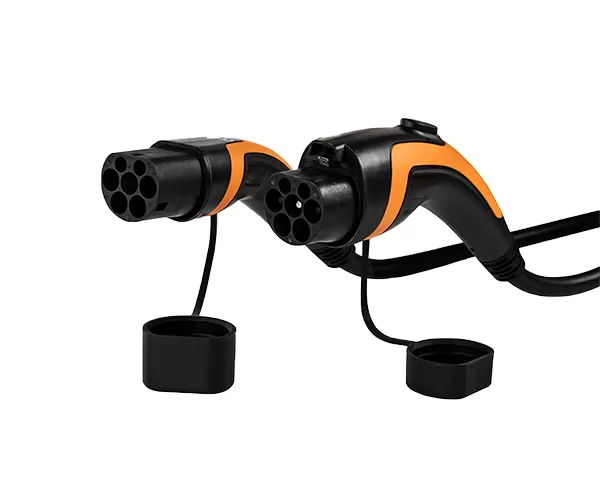
First, please check whether the output plug of the charger and the charging plug of the battery box are firmly inserted. If there is no problem, check whether the fuse tube above the battery box is open or the fuse holder is loose and has poor contact.
In addition, some models need to open the battery lock before charging. If the above faults are eliminated, consider whether the output line of the charger is open. You can use a multimeter to measure the no-load output voltage of the charger (200V gear), if not, it may be that the output line of the electric bike charger is open, turn the charger on, and change the output line to eliminate the fault.
Note: When replacing the output line of the charger, be sure not to reverse the positive and negative poles of the original machine.
Check whether the input power plug of the charger is well connected with the commercial power supply. You can try it by inserting the input plug of the charger into a normal power outlet. If the situation remains the same, open the shell of the charger and observe whether the fuse inside the machine is broken. If it is not broken, first check whether the power input line is in good condition. After eliminating the fault of the power input line, you should check whether the components near the high-voltage area on the circuit board are soldered and whether the fuse holder has poor contact. Focus on checking whether the transformer T1, triode V1, V2, etc. have virtual welding.
In addition, the open circuit of R5 or R6 will also cause the above-mentioned faults. If the fuse in the machine is broken, do not replace the high-ampere fuse tube (the fuse tube of the charger is generally 2A), and should focus on checking D1-D4, V1, Whether V2, R4, R7 and D15, D21 are damaged, if damaged, can be replaced with the same type.
Please note that when the above components are damaged, one or two may be damaged at the same time, and sometimes several may be damaged at the same time. During maintenance, you need to check and replace these components one by one before powering on.
This is mainly caused by the looseness of some components caused by the fact that some users often carry them with the vehicle.
The main manifestations are: when C18 is loose and soldered, it will cause V1 and V2 to work abnormally, and the heat will be very large. In severe cases, the charger shell will be deformed, and the circuit board will be scorched, resulting in damage to V1 and V2. C18 can be re-soldered and checked. V1, V2, R4, R7.
If the fault still cannot be eliminated, it is necessary to check whether there is an open circuit in D15 and D21. In addition, some manufacturers use a double diode for the output rectifier, and one of the open circuits also causes the above fault. Sometimes this fault will cause damage to one of V1 and V2. It needs to be checked and replaced at the same time.
 English
 Deutsch
 Español
 italiano
 русский
 português
 Svenska
 العربية
 Nederland
 norsk
norsk français