The Combined Charging System (CCS) uses a unified interface to meet different charging requirements, simplifying the charging process and improving charging efficiency. This standard was originally designed to address the incompatibility of charging interfaces and communication protocols between different brands and types of electric vehicles, and is now an international standard.
J1772 is the Type 1 plug used for AC charging. A CCS1 vehicle inlet combines the J1772-style AC interface with two dedicated DC contacts. A J1772 AC plug can charge a CCS1-equipped EV through the upper part of its inlet. A CCS1 DC fast-charging plug requires the two lower DC contacts, so it cannot connect to a J1772-only inlet.
| Charging plug | Fits a J1772-only vehicle inlet? | Fits a CCS1 vehicle inlet? |
| J1772 AC plug | Yes, for AC charging | Yes, for AC charging |
| CCS1 DC fast-charging plug | No | Yes, for DC fast charging |
CCS is developed by automotive technology and equipment manufacturers to achieve consistency and standardization of electric vehicle charging. The CCS standard integrates the functions of AC and DC charging, and can meet the needs of slow and fast charging using a single interface, thus improving the convenience of charging. This standard has been widely used in the European and American markets, making different brands of electric vehicles have a unified charging standard.
CCS plug type has Type 1 CCS (CCS1 connector) and Type 2 CCS (CCS2), both of which are composed of their respective AC charging standards plus two DC charging terminals. CCS1 is J1772 AC charging combined with DC terminals, a configuration used in a CCS1 DC EV Charging Socket suitable for the North American market. The ccs2 charging port combines the IEC 62196 Type 2 AC interface with DC charging terminals. The side-by-side pin diagrams for CCS1 and CCS2 show how the contact layout changes between the two connector types.
| CCS1 | CCS2 | |
| Combined vehicle inlet | Type 1 AC interface plus two DC contacts | Type 2 AC interface plus two DC contacts |
| Charging power | Depends on charger and vehicle ratings | Depends on charger and vehicle ratings |
| Communication protocol | SAE J1772 | ISO 15118 |
| Application area | North American | European and Asian |
| Security | - | Additional safety contact door |
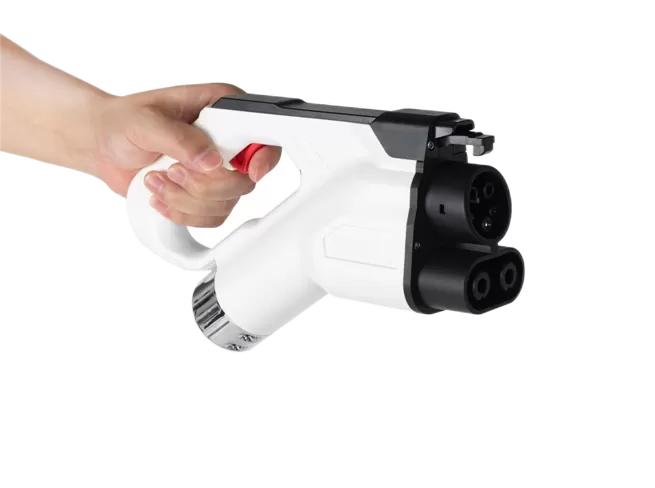
J1772 is widely used in North America, and its excellent compatibility, through level 1 and level 2 charging, suitable for various scenarios, major mainstream companies have provided a wealth of J1772 standard products to meet market demand. A CCS1 vehicle can use a J1772 AC charging plug through the upper part of its inlet. To use a CCS1 DC fast charger, the vehicle needs a CCS1 inlet with the two lower DC contacts. CCS2 uses a different upper interface based on Type 2, so check the vehicle inlet and the station plug before choosing where to charge.
Combining AC and DC charging, CCS has played an important role in the standardization of charging facilities, and has gained international recognition because of its compatibility, fast charging, and safe and reliable charging. CCS can be divided into CCS1 and CCS2 to meet the needs of different regions. With the development of the electric vehicle market, there are also some adapters such as CCS1 to J1772 adapter, and I believe that CCS will continue to optimize in the future to give people a better charging experience.
 English
 Deutsch
 Español
 italiano
 русский
 português
 Svenska
 العربية
 Nederland
 norsk
 français