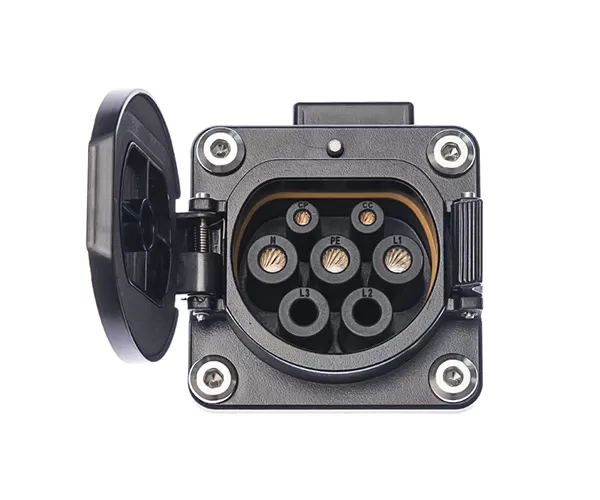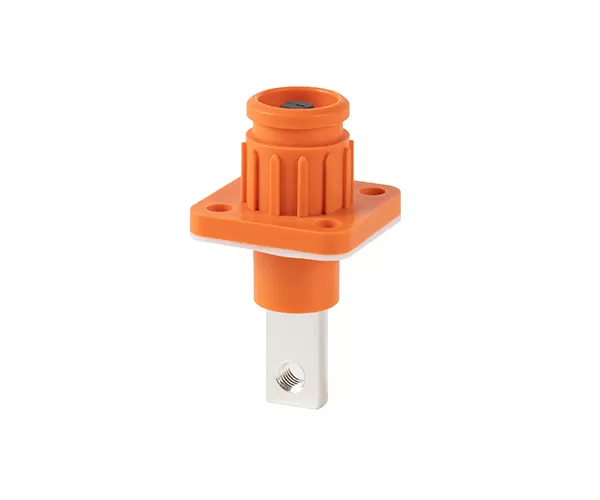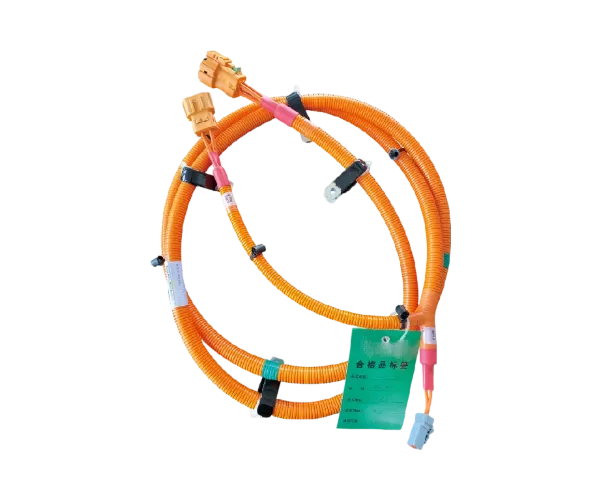
J1772 is a widely used AC charging interface standard in the North American market, developed by the American National Standards Institute (SAE). Type 1 includes a plug and socket, the plug with a buckle for fixing to the socket, consisting of five terminals to form the charging interface, including two LN terminals for transmitting power, two PP and CP terminals for control signals, and a ground terminal PE. The emergence of J1772 makes different brands of cars have a unified charging standard, and new energy vehicles can use public charging piles to replenish energy, solving the problem of endurance of new energy vehicles.
CCS combines AC and DC charging plug modes into one charging interface, making charging faster and more convenient, while J1772 is only suitable for AC charging. The J1772 combined with two DC terminals is the CCS2 plug.
J1772 has two charging levels: Level 1 and Level 2, the main difference between them is the difference in voltage. Level 1 uses a household standard power socket of 120 volts and 15-20 amps, which makes the charging speed slow, but the socket at home can directly replenish energy for new energy vehicles, which is more convenient. Level 2 uses a 240-volt power supply, which can provide higher charging power. But charging equipment requires professional installation.
Limited by AC and voltage, the charging rate of the J1772 standard connector is relatively low, generally takes several to ten hours to fill the car, but the voltage of Level 2 is twice that of Level 1, and the current is also larger, so the charging rate of Level 2 is much faster. Therefore, the current mainstream of the J1772 connector is still the Level 2 charging gun.
The J1772 connector is suitable for cars manufactured and sold in North America, with the exception of tesla cars, which have their own NACS standard.
The purchase of the J1772 combo connector to consider the voltage situation at home, where permitted, it is recommended to choose the Level 2 charging gun, if the charging gun is installed outdoors, then its temperature resistance, water resistance must meet the corresponding standards, such as IP55 or IP67 waterproof standards, and finally according to personal preferences to choose a product that meets the needs of the look and feel.
Since its release in 2010, the J1772 standard has been tested in the field of new energy vehicles for more than ten years. It is safe, stable and compatible, and is widely used in the North American market, which has an important role in promoting the development of the new energy vehicle industry. When selecting the J1772 standard charging connector, users can comprehensively consider the structural size, impedance matching, shielding effect, whether there is an anti-misinsertion design, working environment adaptability, versatility and interchangeability, locking function, brand and quality and other factors.
 English
 Deutsch
 Español
 italiano
 русский
 português
 Svenska
 العربية
 Nederland
 norsk
 français