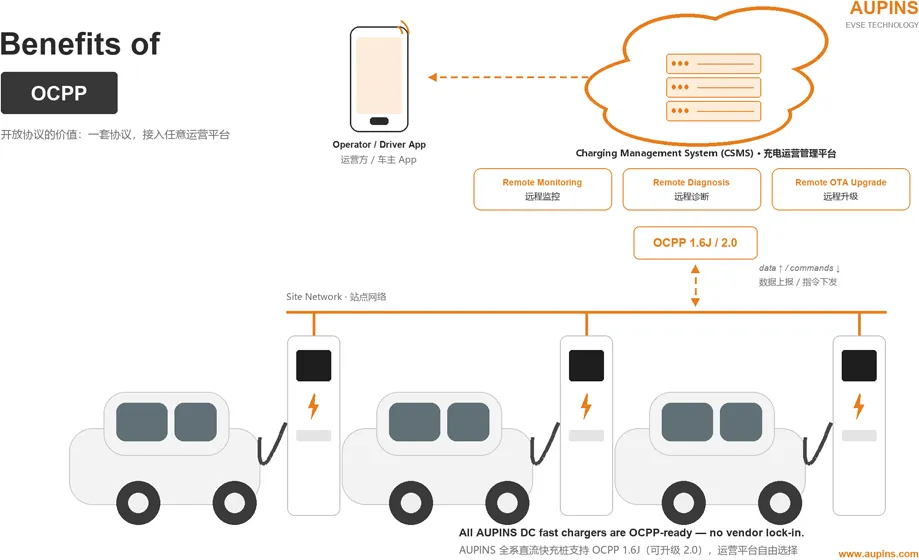
OCPP is the open language between a charging station and its cloud management platform. If your charger speaks OCPP, it can connect to any OCPP-compatible platform — today's one, or a different one five years from now.It works both ways: the charger sends up status, metering and fault data, and the platform sends down commands — remote start/stop, power limits, firmware updates.
It works both ways: the charger sends up status, metering and fault data, and the platform sends down commands — remote start/stop, power limits, firmware updates.
No vendor lock-in. Chargers last 7–10 years; software platforms change much faster. OCPP keeps the two decoupled, so you can switch platforms without replacing hardware.
Run everything remotely. Monitoring, fault diagnosis and firmware updates are done from the dashboard, not from a service truck. Most issues are solved before anyone drives to the site.
Smarter power use. The platform can cap or schedule charging power per site — one 400 kW grid connection can then serve several 150 kW chargers safely.
Easy payments. RFID, mobile app or card payments all run through the same OCPP session layer. Adding a payment method is a software change, not a retrofit.
A clear upgrade path. Most chargers today ship with OCPP 1.6J; the new 2.0.1 adds stronger security and native plug-and-charge support. Buy 1.6J now — but only with a written commitment to upgrade to 2.0.1.
Every AUPINS DC fast charger, including the EF160 series (60–240 kW), ships with OCPP 1.6J over secure WebSocket (WSS), an upgrade path to OCPP 2.0.1, and remote monitoring, remote diagnosis and remote firmware upgrade as standard functions — not paid add-ons.
Looking for an OCPP-ready DC fast charger? Talk to AUPINS about the EF160 series.
 English
 Deutsch
 Español
 italiano
 русский
 português
 Svenska
 العربية
 Nederland
 norsk
 français