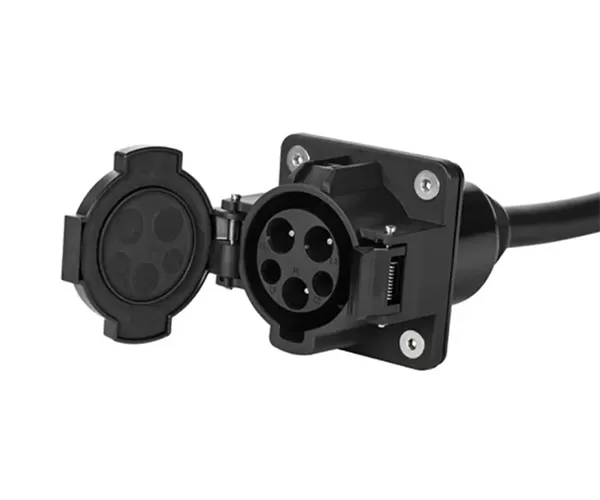
A CCS2 charging socket is not simply a port installed on an electric vehicle. It is the vehicle-side interface responsible for connecting the charging system to the vehicle's electrical architecture while handling power transmission, signal communication, mechanical mating, and environmental exposure. For manufacturers sourcing a CCS2 charging socket, the supplier's specification should therefore be reviewed as a complete system rather than judged by current rating or connector appearance alone.
A CCS2 charging socket is the vehicle inlet used by the Combined Charging System 2, combining the Type 2 AC interface with additional DC contacts for DC charging. This configuration allows one vehicle inlet to support both AC charging and high-power DC charging.
The design of the socket includes more than the visible housing. Power contacts, signal contacts, insulation, locking components, sealing structures, mounting dimensions, and thermal characteristics all contribute to the performance of the finished interface.
For manufacturers, compatibility is especially important because the socket must work correctly with the mating charging connector and the vehicle's electrical and mechanical systems. IEC 62196-3 specifies dimensional compatibility requirements for DC and AC/DC vehicle couplers and vehicle inlets.
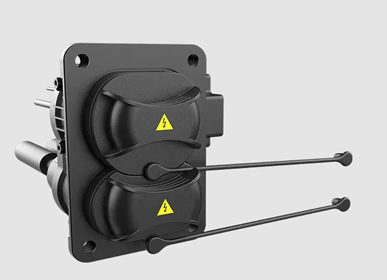
The specification of a CCS2 socket should cover electrical, mechanical, environmental, and installation requirements. A supplier that provides only basic dimensions and a nominal current rating leaves important engineering questions unanswered.
| Specification | What to Check | Why It Matters |
| Rated voltage | AC and DC voltage range | Confirms electrical compatibility |
| Rated current | Continuous and application-specific current | Determines power-transfer capability |
| Contact design | Power and signal contact structure | Affects conductivity and durability |
| Mating life | Mechanical cycle rating | Indicates expected service life |
| Temperature | Operating temperature range | Supports reliable operation |
| Protection | Sealing and insulation | Helps resist moisture and contamination |
| Locking | Locking and interlock design | Supports safe connection |
| Dimensions | Mounting and interface dimensions | Determines vehicle integration |
Current capacity deserves particular attention. A higher current number does not automatically indicate a better socket. Contact resistance, conductor size, thermal dissipation, ambient temperature, charging duration, and housing design all influence actual operating performance.
For this reason, buyers should ask how a supplier's current rating was tested and whether the stated value applies to continuous operation, specific ambient conditions, or a particular thermal-management configuration.
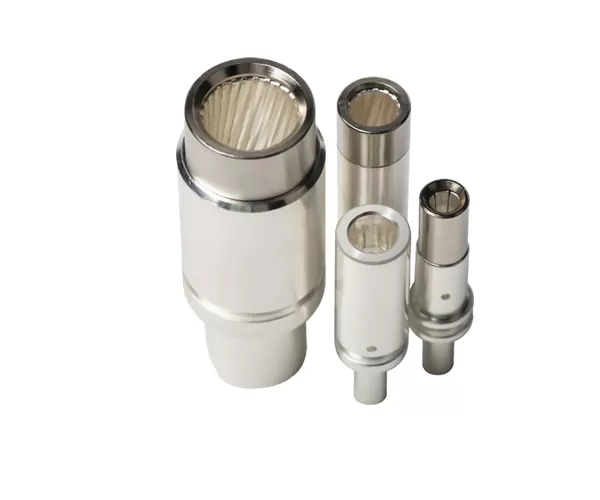
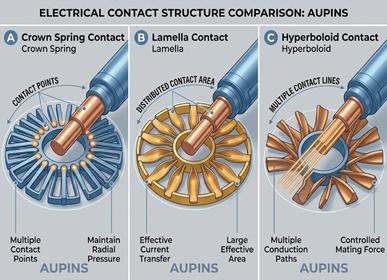
The internal contact system of CCS2 pins has a direct influence on electrical resistance, heat generation, and connection stability. When current increases, even relatively small contact resistance can contribute to additional heat.
This makes contact geometry and material selection important parts of a CCS2 charging socket specification. Spring characteristics, contact pressure, conductive material, plating, and mating dimensions should be evaluated together.
A well-designed contact interface should maintain reliable electrical conduction while accommodating repeated mating. Mechanical life is therefore another important supplier specification, particularly for public charging, commercial vehicles, and fleet applications where charging connections may be used frequently.
Thermal management should also be evaluated at the system level. The socket, contacts, conductors, cable, housing, and cooling arrangement can all influence the temperature reached during charging. A component-level current rating should not be treated as a guarantee of identical performance in every vehicle or charging environment.
Supplier evaluation of a CCS2 socket should go beyond comparing catalog prices and nominal specifications. The manufacturer should be able to provide enough technical information for the buyer's engineering team to verify compatibility and performance before moving to mass production.
Electrical capability: Confirm rated voltage, current, contact resistance, and applicable test conditions.
Mechanical performance: Review mating cycles, insertion and extraction force, locking behavior, and dimensional tolerances.
Environmental performance: Check operating temperature, sealing, insulation, vibration resistance, and exposure to moisture or contamination.
Documentation: Request drawings, material information, test reports, specifications, and relevant quality documentation.
Customization capability: Determine whether mounting dimensions, housing configuration, contact arrangement, or cable connection can be adapted.
A supplier should also understand the distinction between a vehicle inlet and the complete EV charging system. IEC 61851-1 addresses general requirements for conductive charging systems, including operating conditions and electrical safety, while the socket itself must meet its applicable connector requirements.
Standards provide a useful framework for evaluating compatibility, but buyers should confirm which standard editions and requirements apply to their target market and application.
IEC 62196 is central to the physical interface and dimensional compatibility of vehicle couplers and inlets. For the wider Combined Charging System architecture, CharIN provides CCS technical information covering the connector system, charging architecture, communication, and implementation considerations.
A supplier should therefore be able to explain not only which standards its product references, but also which specific requirements have been tested and documented. This distinction is important when a manufacturer is integrating the socket into a new vehicle platform or charging system.
AUPINS provides electrical contact and EV charging solutions for manufacturers developing charging-related products. Its experience with electrical contacts, connector structures, and charging applications allows the socket and contact requirements to be considered together.
For manufacturers evaluating a CCS2 socket, AUPINS can support the broader engineering process around electrical contact performance, connector configuration, and application-specific requirements. The company also provides charging-related products and solutions for different EV charging scenarios.
The development process can involve more than selecting a standard component. Vehicle installation space, mating connector geometry, cable routing, current requirements, thermal conditions, and environmental exposure may all need to be considered before the final configuration is determined.
Where a standard catalog configuration does not match the intended application, customization of relevant mechanical or electrical characteristics can also become part of the supplier discussion.
A reliable CCS2 charging socket needs to satisfy much more than a nominal voltage and current rating. Contact structure, resistance, mating life, thermal behavior, sealing, locking, dimensions, and vehicle integration all contribute to the performance of the complete charging interface.
For buyers, a practical supplier checklist should therefore combine electrical specifications, mechanical performance, environmental requirements, applicable standards, technical documentation, and customization capability. Reviewing these factors before sampling can help manufacturers identify potential integration issues earlier and establish clearer requirements for production.
A CCS2 charging socket is the vehicle-side inlet used for Combined Charging System 2 applications. It combines the Type 2 interface with additional DC contacts to support AC and DC charging.
IEC 62196-3 is a key standard covering dimensional compatibility requirements for DC and AC/DC vehicle couplers and vehicle inlets.
Important specifications include voltage, current, contact resistance, mechanical life, operating temperature, sealing, locking, dimensions, test conditions, and installation requirements.
Not necessarily. Actual performance also depends on contact resistance, thermal management, conductor size, ambient conditions, and the design of the complete charging system.
Contact design affects electrical resistance, heat generation, mating stability, and mechanical durability. These factors become increasingly important in high-current charging applications.
Depending on the supplier and application, dimensions, housing configuration, contact arrangement, mounting structure, and other characteristics may be adapted to specific vehicle or charging-system requirements.
 English
 Deutsch
 Español
 italiano
 русский
 português
 Svenska
 العربية
 Nederland
 norsk
norsk français