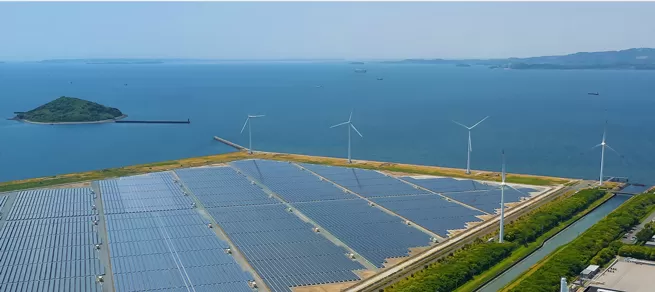
A study recently released by the Lawrence Berkeley National Laboratory, an official research institution in the United States, proves that as the cost of solar, wind and battery energy storage falls, by 2035, the share of clean electricity in Japan's energy mix will increase by 10% or more. will reach 90%.
The study also found that Japan's grid, with additional battery storage and interregional transmission lines, could provide reliable power without coal-fired generation or new gas-fired plants.
Last year, the Group of Seven nations, including Japan, pledged to broadly decarbonize the power sector by 2035 to combat climate change, but the Japanese government has yet to lay out a clear plan for that goal.
Japan's resources are scarce, and almost all energy used in the power industry depends on imports, so energy security is facing huge risks. Currently, clean energy, including solar, wind, hydropower, biomass, hydrogen and nuclear power, accounts for about 24% of Japan's power mix.
The study pointed out that increasing the proportion of clean energy to 90% can reduce the cost of power generation by 6% compared with 2020 levels, and the emissions of the power industry can be reduced by 92%.
But the study also said that to achieve this goal, Japan needs to develop clear policies, such as medium-term targets after 2030, and corresponding renewable energy deployment plans to take advantage of economic, environmental and energy security benefits.
Japan aims to reduce greenhouse gas emissions by 46% from 2013 levels by 2030, increase the share of renewable energy in the electricity mix to 36-38%, and increase the share of nuclear power from 6% in 2019 Increase to 20-22%. Japan has pledged to become carbon neutral by 2050.


 English
 Deutsch
 Español
 italiano
 русский
 português
 Svenska
 العربية
 Nederland
 norsk
norsk français