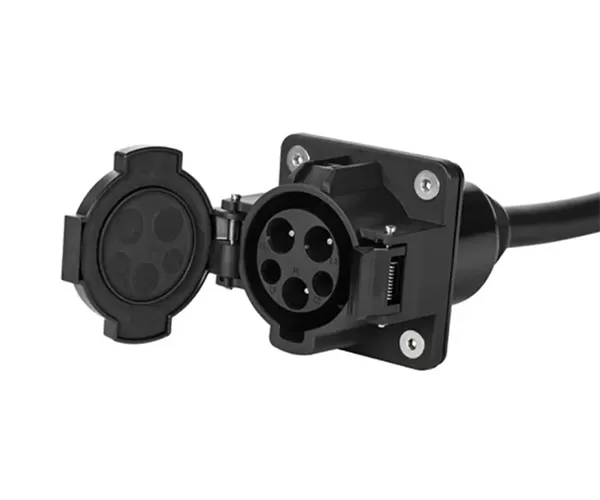
In an ISO 15118-20 charging system, the Electric Vehicle Communication Controller (EVCC) and Supply Equipment Communication Controller (SECC) act as communication endpoints between an electric vehicle and EVSE. Although they work together during the same charging session, they serve different sides of the system. Understanding this distinction helps EV charger manufacturers select suitable communication hardware and build a practical charging architecture.
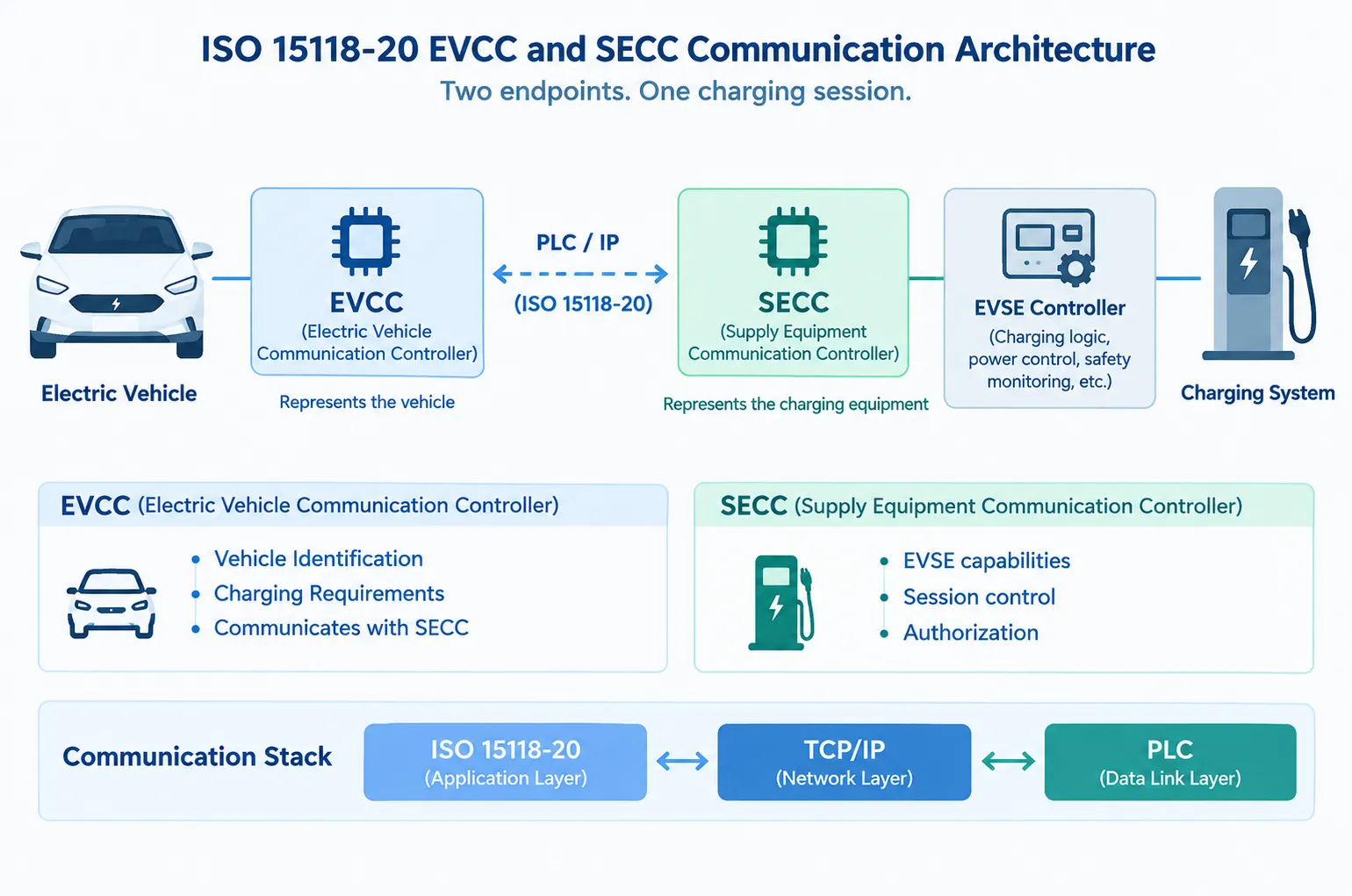
The SECC is the communication controller on the EVSE side, while the EVCC is the corresponding communication controller inside the electric vehicle.
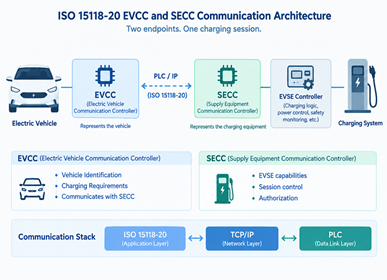
The EVCC represents the vehicle during charging and communicates information such as vehicle identification and charging requirements. The SECC represents the charging equipment and communicates EVSE capabilities and charging-session information.
| Aspect | SECC | EVCC |
| Location | EVSE / charging station | Electric vehicle |
| Full name | Supply Equipment Communication Controller | Electric Vehicle Communication Controller |
| Represents | Charging equipment | Electric vehicle |
| Host system | EVSE controller | Vehicle control system |
| Communication | PLC and IP-based | PLC and IP-based |
| Typical functions | Session control, authorization, EVSE capabilities | Vehicle identification, charging requirements |
A SECC is not necessarily the complete EV charger controller. In a modular EVSE architecture, it can handle vehicle communication while another controller manages power conversion, contactors, safety monitoring and other charging functions.
For manufacturers, a dedicated SECC controller can provide the communication layer between an existing EVSE controller and an ISO 15118-20 compatible vehicle.
SECC and EVCC are the two communication endpoints of an ISO 15118-20 charging session, with PLC and IP networking providing the underlying communication path.
A simplified architecture is:
EV → EVCC → PLC → IP/TCP → SECC → EVSE Controller → Charging System
This separation allows charging manufacturers to keep standardized vehicle communication independent from application-specific charging control.
For example, an AC wallbox may connect an embedded SECC module to its main MCU through UART. The main controller can continue managing charging logic and hardware functions while the SECC handles standardized communication.
AUPINS AP-SE-B is designed for this type of embedded architecture. It supports ISO 15118-2 and ISO 15118-20, together with CCS1, CCS2 and NACS interfaces. Its 50 mm × 10 mm × 30 mm dimensions, two UART interfaces and USB interface support integration with an existing EVSE controller.
When evaluating an EVCC charge controller, manufacturers should likewise consider the host interface, communication hardware and software architecture rather than looking at protocol support alone.
SECC-EVCC communication combines ISO 15118-20 application-layer functions with underlying PLC and IP-based communication technologies.
ISO 15118-20 defines high-level communication between the vehicle and EVSE, while the underlying communication layers provide the path for exchanging structured messages.
CharIN's ISO 15118 overview explains the relationship between ISO 15118-20, Power Line Communication (PLC), TCP/IP, Plug & Charge and bidirectional charging.
ISO 15118-20 is particularly relevant to newer charging systems. It defines second-generation network and application-layer communication requirements between EVCC and SECC and includes communication procedures for bidirectional power transfer. The published standard contains 561 pages, reflecting its broad technical scope.
For manufacturers, “ISO 15118-20 compatible” should therefore be checked against the specific ISO version and functions required by the target charging product.
Successful SECC-EVCC integration requires checking protocol compatibility, communication hardware, host interfaces, security functions, connector architecture and interoperability.
First, confirm the required ISO 15118-20 version and PLC implementation. For CCS-based charging, the PLC layer, control-pilot signaling and connector hardware need to operate as one complete system.
A CCS2 charging socket is an important part of the physical interface, but it does not provide the complete ISO 1511-208 communication architecture by itself.
Manufacturers should also confirm whether the selected communication module supports the charging modes and advanced functions required by the final product.
The integration boundary between the SECC module and the main EVSE controller should be clearly defined. UART, USB or another interface may be used depending on the hardware design.
Engineers should determine which functions are handled by the communication module and which remain in the main processor. This division affects firmware development, diagnostics, error handling and future protocol upgrades.
Advanced functions such as Plug & Charge require appropriate security and certificate-management functions. Interoperability testing should also be performed with representative EV and EVSE configurations before mass production.
For charging applications involving different connector standards, the GB/T to CCS2 adapter can also be considered as part of the broader charging solution.
AUPINS provides embedded communication hardware designed to integrate ISO 15118-20 PLC capabilities into EV charging equipment.
The AUPINS AP-SE-B supports ISO 15118-2 and ISO 15118-20 and is designed for AC EVSE applications. It supports CCS1, CCS2 and NACS interfaces and operates from -40°C to +85°C.
Its compact 50 mm × 10 mm × 30 mm form factor and multiple host interfaces make it suitable for integrating communication functions into existing charging-control architectures.
For EV charger manufacturers, this modular approach can separate vehicle communication from core charging-control functions without requiring the complete EVSE controller to be redesigned.
IEC 61851-24:2023 provides a relevant reference for digital communication between an EV and DC EV supply equipment, helping manufacturers evaluate communication requirements alongside the higher-level ISO 15118-20 framework during charger development.
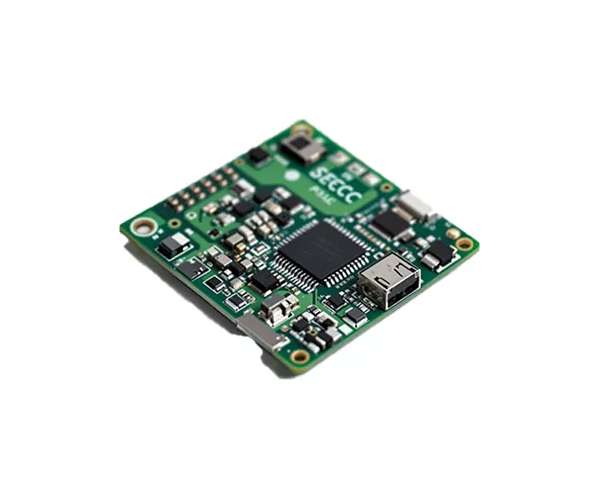
SECC and EVCC perform complementary roles in ISO 15118-20 communication. The EVCC represents the vehicle, while the SECC represents the EVSE. Their communication relies on ISO 15118-20 together with the underlying PLC and IP networking architecture.
For charger manufacturers, successful integration depends on more than protocol support. ISO 15118-20 version, PLC implementation, host interface, security, connector configuration and interoperability testing should all be considered when selecting communication hardware.
A modular SECC architecture can help EVSE manufacturers add standardized vehicle communication while maintaining a clear separation between communication and charging-control functions.
The SECC operates on the EVSE side, while the EVCC operates inside the electric vehicle. They communicate as two endpoints of an ISO 15118-20 charging session.
No. An SECC primarily handles vehicle-EVSE communication. Other controllers may manage power conversion, contactors, safety monitoring and charging functions.
ISO 15118-20 commonly uses PLC together with IP-based communication for the vehicle-EVSE communication path.
Yes. ISO 15118-20 includes communication procedures for bidirectional power transfer.
No. A complete Plug & Charge implementation also requires appropriate security, certificate management and supporting backend functions.
They should check ISO 15118-20 version support, PLC implementation, host interfaces, CP/PP signaling, security functions, connector compatibility and interoperability requirements.
 English
 Deutsch
 Español
 italiano
 русский
 português
 Svenska
 العربية
 Nederland
 norsk
norsk français