If you work in EV charging, you have seen the number on datasheets, tenders and conference slides: ISO 15118-20.
It is usually mentioned in one of three ways — as a compliance requirement, as a feature claim, or as a reason to replace hardware. Rarely is it explained as what it actually is: a communication standard that defines how vehicles and chargers negotiate everything about a charging session, from identity to power direction.
This guide covers what ISO 15118-20 is, how it relates to the rest of the ISO 15118 framework, what it adds over the previous generation, and what it changes for anyone designing, buying or operating charging equipment.
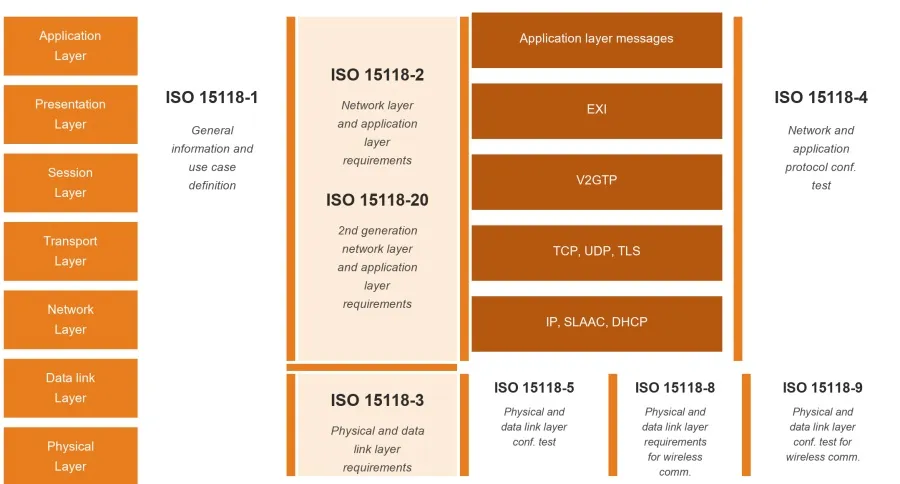
ISO 15118 is officially titled "Road vehicles — Vehicle-to-grid communication interface." It is not one document but a series of parts, each covering a layer of the vehicle-charger communication stack:
Part | What it covers |
ISO 15118-2 | First-generation network and application layer — the version that put Plug & Charge on the map |
ISO 15118-3 | Physical and data link layer for Power Line Communication (PLC) over the charging cable |
ISO 15118-4 / -5 | Conformance test architecture and physical layer test requirements |
ISO 15118-20 | Second-generation network and application layer — the subject of this guide |
Two points worth internalising:
First, ISO 15118-20 is the application layer, not the cable technology. The signals still travel over the charging cable as PLC, defined by the -3 part. What -20 redefines is the conversation itself: the messages, the security model and the services.
Second, ISO 15118-20 does not delete ISO 15118-2. Both generations exist. Devices implement one or the other — and the market is moving toward the second generation, driven by regulation, bidirectional charging and the maturing Plug & Charge ecosystem.
The second generation is not a patch. It is a redesign of the application layer with the same goal — standardised, secure vehicle-charger communication — and a much larger scope.
Capability | ISO 15118-2 | ISO 15118-20 |
External Identification (EIM) | ✅ | ✅ |
Plug & Charge (PnC) | ✅ | ✅ |
Security | TLS 1.2 | TLS 1.3 |
Energy transfer | Forward charging (AC / DC) | Forward charging + bidirectional power transfer (BPT) |
Charge control granularity | Session-level parameters | Redesigned charge loop with finer, dynamic control |
Application scope | Wired conductive charging | Conductive charging and readiness for wireless power transfer (WPT) |
Certificate handling | Contract certificate model | Extended certificate management flows |
Three of these deserve a closer look, because they are what buyers actually ask about.
This is the headline feature. ISO 15118-2 assumed energy flows one way: from the grid to the vehicle. ISO 15118-20 defines the messages for the vehicle to discharge — into a home (V2H), a building (V2B) or the grid (V2G).
That changes what a "charger" is. With BPT support, the charging session includes negotiating discharge power, schedules and grid interaction. For manufacturers, the consequence is structural: a communication module that only implements ISO 15118-2 cannot be upgraded to bidirectional by firmware, because the procedures do not exist in that generation. This is the single most common specification mistake in V2G projects.
ISO 15118-20 moves to TLS 1.3 and extends certificate management. Plug & Charge depends on a working certificate chain — contract certificates, OEM provisioning, a PKI that can issue, renew and revoke. The second generation carries these flows inside the standard more completely, which matters for anyone planning a PnC rollout at fleet or public scale.
The redesigned charge loop gives both sides finer control over power during a session, supporting dynamic schedules and grid-responsive behaviour — the foundation for smart charging and coordinated charging at site level.
In datasheets, ISO 15118-20 capability usually appears as three named functions. They answer different questions:
EIM (External Identification Means) — "Who is charging?" is answered by something outside the session: an RFID card, an app, a backend token. EIM is the fastest to deploy and still the workhorse for public charging.
PnC (Plug & Charge) — "Who is charging?" is answered by the certificate itself. The driver plugs in; authentication, billing and contract handling happen automatically over the secure channel. No card, no app.
BPT (V2X) — "Which direction does the power flow?" can be answered with both. V2H backup power, V2G grid services and building-level energy management all run on this.
A charger can implement any combination. Many real deployments start with EIM, add PnC as the PKI ecosystem matures, and treat BPT as the roadmap item that decides which hardware generation to buy.
The sequence below is common to both generations — the details differ, the shape does not:
1. SLAC — the vehicle and charger discover each other electrically on the same cable.
2. SDP — the vehicle finds the charger's communication endpoint.
3. Session setup — the two ends agree on protocol version and supported services.
4. Authentication — EIM or PnC, over an encrypted channel.
5. Charge parameter discovery — capabilities, limits, schedules.
6. Charge loop — power flows, with ongoing adjustment and monitoring.
7. Session stop — clean closure, metering and billing data handed to the operator side.
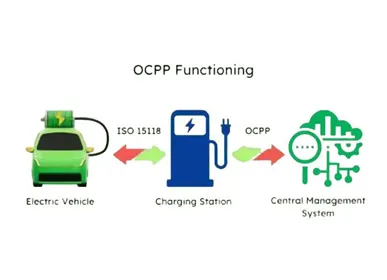
Note what is not in this sequence: pricing policy, roaming, site-level load balancing, firmware updates. Those belong to the charger-to-cloud link — handled by OCPP, a different protocol on a different link. Confusing the two is the most frequent buyer question in this space.
Charger manufacturers — if your roadmap includes Plug & Charge, bidirectional charging, or sales into markets with ISO 15118-20 compliance timelines, the second generation is the design target. Retrofit paths exist for AC platforms (see our retrofit guide), but they depend on the communication module, not on firmware wishes.
Fleet and site operators — you do not implement the standard; you specify it. The practical question for a supplier is not "ISO 15118?" but "which generation, and which functions — EIM, PnC, BPT?" A charger specified for ISO 15118-2 today cannot become V2G-capable by update later.
Energy and VPP providers — the aggregated-fleet business model depends on BPT-capable communication end to end. ISO 15118-20 is the layer that makes vehicle participation negotiable and authenticated.
Regulatory direction reinforces this: EU market requirements for public charging infrastructure increasingly reference the second generation, with implementation timelines that make hardware decisions urgent — the logic behind our AFIR compliance checklist.
For a manufacturer with a working AC main controller, the fastest route to ISO 15118-20 is not a new controller. It is an embedded SECC module that carries the second-generation protocol stack and the PLC communication, while the existing controller keeps doing what it does: power switching, metering, protection.
That is the design role of the AUPINS AP-SE-B core board: an SECC PLC communication module for IEC/SAE AC charging equipment, supporting ISO 15118-2 EIM/PnC and ISO 15118-20 EIM/PnC/BPT (V2X) across CCS1, CCS2 and NACS charging interfaces.
50mm × 10mm × 30mm footprint, mounted via a 2.0mm-pitch 18-pin single-row header
Two UART interfaces plus one USB port for configuration, upgrade and diagnostics
Optional PWM generation, CP detection, PD/PP detection and E-state control
-40°C to +85°C operating range; 5V (±0.2V) supply, >600mA
OTA firmware upgrade with log storage and retrieval
The separation matters as much as the capability: the vehicle link and the cloud link stay on different components, which keeps certification scope, firmware ownership and fault isolation clean.
The second edition of the framework — including Part 20 — was published in 2022, defining the second-generation network and application layer.
No. It applies to AC and DC conductive charging, and its framework is designed with wireless power transfer in scope. For AC charging specifically, it is the generation that brings Plug & Charge and bidirectional capability to wallboxes.
Plug & Charge exists in both generations. But if your roadmap includes V2G or V2H, or your target markets reference the second generation for compliance, ISO 15118-20 is the safer specification.
Only if its communication hardware implements the second-generation procedures. A module limited to ISO 15118-2 cannot gain bidirectional power transfer through a firmware update.
No. ISO 15118-20 is the vehicle-to-charger link; OCPP is the charger-to-cloud link. A commercial charger needs both.
EIM authenticates by external means (card, app), PnC authenticates by certificate within the session, and BPT enables bidirectional power flow. They are separate functions; a charger may implement any combination.
ISO 15118-20 is the point where EV charging stops being a one-way electrical transaction and becomes a negotiated, authenticated, potentially bidirectional service. For manufacturers, it sets the hardware generation. For operators, it sets what to demand from suppliers. For both, the practical question is no longer whether the second generation matters — it is which functions you need, and whether the hardware you choose today can carry them.
CTA:Evaluating ISO 15118-20 for your AC charger platform? Request the AP-SE-B specification, pin definitions and an evaluation sample from AUPINS.

 English
 Deutsch
 Español
 italiano
 русский
 português
 Svenska
 العربية
 Nederland
 norsk
 français