Types of electric car charger refer to charging equipment categories designed to deliver electricity to an electric vehicle at different power levels, speeds, connector standards and installation scenarios. For EV drivers, property owners, fleet operators and charging network investors, choosing the right charger type affects charging speed, installation cost, user experience, grid demand and long-term operation.
As EV adoption grows, charger selection is becoming a business decision as much as a technical decision. AUPINS provides EV Charger solutions, charging cables, portable chargers, AC wall-mounted chargers and DC fast chargers for residential, commercial and public charging applications.
The main types of electric car charger are Level 1 AC chargers, Level 2 AC chargers and DC fast chargers. These charger types differ by input voltage, output power, charging time, installation cost and typical use scenario.
Level 1 charging uses a standard 120V AC outlet in North America and is mainly used for emergency, overnight or low-mileage charging. The U.S. Alternative Fuels Data Center explains that Level 1 charging provides approximately 5 miles of range per 1 hour of charging, and charging time may reach 20 hours or more depending on battery size and state of charge.
Level 2 charging uses 240V residential or 208V commercial AC service. It is the most common choice for homes, workplaces, hotels, parking lots and destination charging. AFDC estimates Level 2 charging can provide around 25 miles of range per hour, while the U.S. Department of Transportation notes that Level 2 chargers can charge many battery electric vehicles to 80% in 4–10 hours.
DC fast charging, also called DCFC or Level 3 charging, converts AC power to DC outside the vehicle and sends high-power DC directly to the battery system. It is mainly used along highways, public charging hubs, fleet depots and commercial charging stations. DOT states that DC fast charging can charge a BEV to 80% in about 20 minutes to 1 hour.
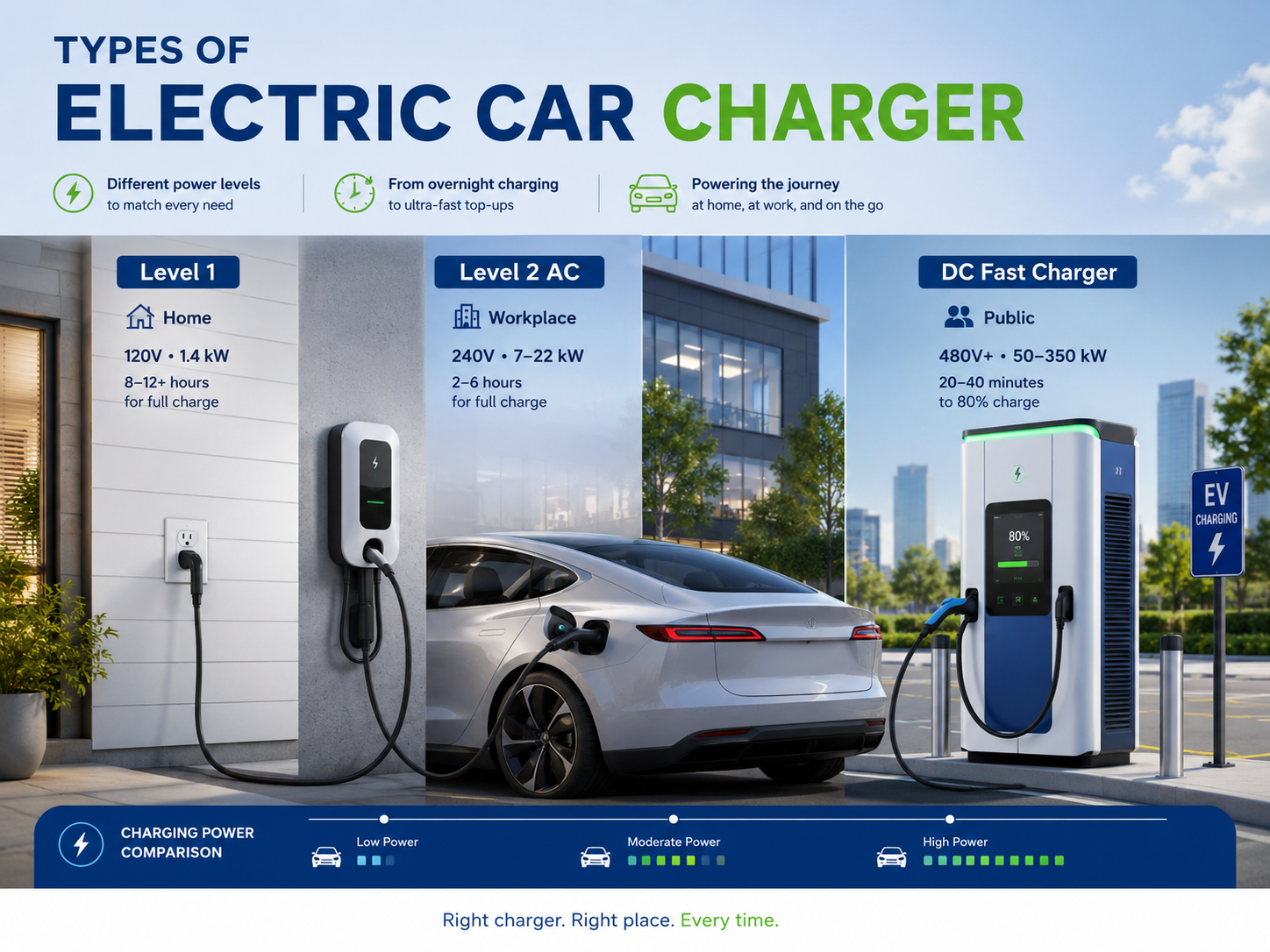
Electric car charger types should be compared by power level, charging speed, installation needs, cost logic and user scenario. The table below gives a practical buyer comparison.
| Charger Type | Typical Power / Voltage | Approximate Charging Speed | Best Use Case | Buyer Consideration |
| Level 1 AC Charger | 120V AC, about 1–2kW | Around 5 miles per hour | Backup, low-mileage drivers, occasional charging | Slow speed, minimal installation |
| Level 2 AC Charger | 208–240V AC, about 2.9–19.2kW | Around 25 miles per hour | Home, workplace, hotel, parking, retail | Best balance of speed and cost |
| Portable AC Charger | Usually 2.3–7kW | Depends on plug and current | Travel, emergency, flexible home use | Requires compatible plug and safety protection |
| DC Fast Charger | 50kW–500kW+ | 100–200+ miles per 30 minutes | Highway, public hubs, fleets | Higher grid, installation and maintenance cost |
| Ultra-Fast DC Charger | 150kW+ | Fastest public charging | Highway corridors, premium charging networks | Vehicle battery acceptance may limit speed |
For daily use, Level 2 AC charging is often the most practical solution. For long-distance travel and high-turnover commercial sites, DC fast charging is more suitable. For occasional users, a portable AC charger can provide flexibility without a fixed charging station.
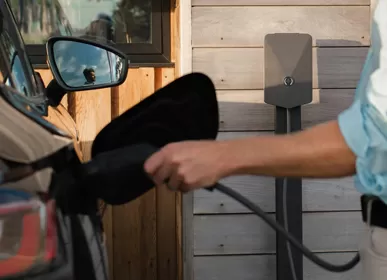
Electric car charger types differ by where they are installed and how users interact with them. A home charger, a workplace charger and a public fast charger may all charge the same EV, but they are designed for different duty cycles and business models.
For residential and workplace charging, wall-mounted AC chargers are usually preferred because most vehicles remain parked for several hours. The AUPINS C5 Series AC Wall-mounted Charger provides 7kW, 11kW and 22kW options, supports one-phase and three-phase charging, and includes IP55 protection, overvoltage, overcurrent and leakage protection. This makes it suitable for homes, offices, apartments and commercial parking areas.
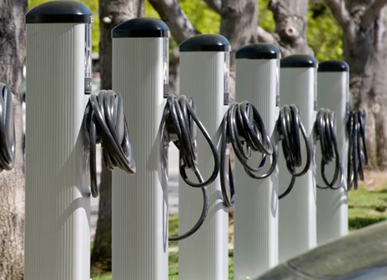
For public charging, charging speed and charger uptime are more important. The AUPINS EF040 Series Public DC Fast EV Charger supports up to 40kW output, CCS Combo-2 and CHAdeMO standards, wall-mounted or pole-mounted installation, 7-inch LCD interface, OCPP 1.6J connectivity, IP54 and IK10 protection, and up to 94% conversion efficiency.
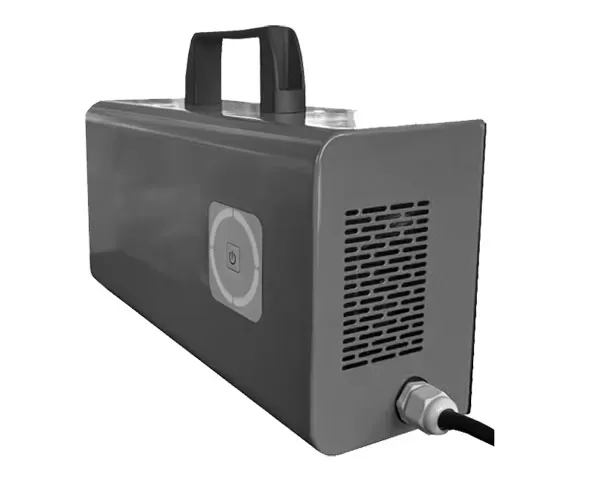
For travel and backup charging, portable chargers are useful because they are compact and easy to carry. AUPINS portable EV chargers support multiple connector and plug options, helping drivers charge in more flexible environments when fixed infrastructure is unavailable.
Electric car charger standards define how EV chargers connect, communicate and operate safely with electric vehicles. For buyers, connector compatibility and safety compliance are as important as output power.
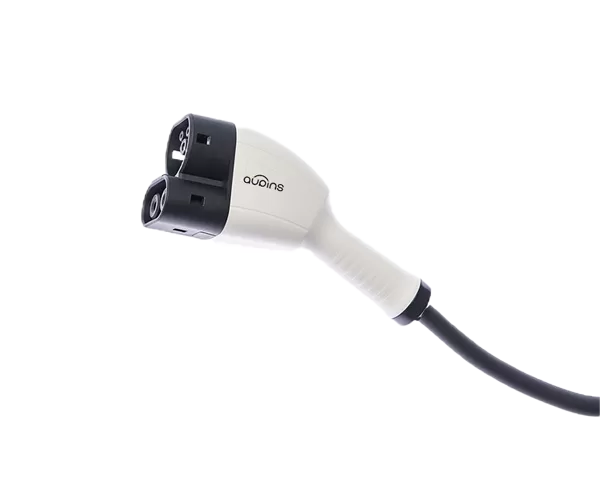
Common connector systems include Type 1 / SAE J1772, Type 2 / IEC 62196, CCS, CHAdeMO, NACS / J3400 and GB/T. The right choice depends on the target market and vehicle population. AUPINS offers charging products and accessories covering Type 1, Type 2, Tesla/NACS, GB/T, CCS Combo-2 and CHAdeMO-related charging needs.
Safety standards are central to charger design. IEC 61851-1:2017 applies to EV supply equipment with rated supply voltage up to 1,000V AC or 1,500V DC and covers operating conditions, EV connection requirements and electrical safety. For physical connectors, Type 2 charging systems are commonly associated with IEC 62196 in European and international markets.
Smart charging features are becoming increasingly important. Networked chargers may support RFID, app control, contactless payment, OCPP, remote monitoring, load balancing, OTA upgrades and diagnostics. These features help charging operators improve uptime, billing, maintenance and energy management. According to the International Energy Agency’s electric vehicle charging analysis, more than 1.3 million public charging points were added globally in 2024, representing growth of over 30% compared with the previous year.
Choosing the right type of electric car charger means matching charger power, connector standard, installation site, user dwell time, grid capacity and business model. The best charger is not always the fastest one; it is the one that fits the real charging scenario.
For homes, apartments and workplaces, Level 2 AC charging is usually the best starting point because vehicles stay parked long enough for practical daily charging. For hotels, office buildings, retail centers and parking operators, AC chargers can support destination charging while keeping installation costs manageable. For highway service areas, airports, fleets and gas stations, DC fast chargers create faster turnover and better public charging convenience.
Before buying, confirm input power, output power, connector type, cable length, protection rating, payment method, communication protocol, certification, installation environment and after-sales support. AUPINS helps customers select AC chargers, DC fast chargers, portable chargers, charging cables and accessories according to residential, commercial, fleet and public charging scenarios.
The main types of electric car charger are Level 1 AC, Level 2 AC and DC fast charging. Level 1 is simple but slow. Level 2 is the most practical daily charging option for homes, workplaces and destination sites. DC fast charging is best for public networks, fleets and highway corridors where charging time matters most.
For buyers and charging operators, charger selection should be based on site conditions, user behavior, power availability, vehicle compatibility and long-term operating needs. AUPINS provides EV chargers, AC wall-mounted chargers, portable chargers, DC fast chargers, charging cables and accessories to support safe, efficient and scalable EV charging deployment.
The three main types are Level 1 AC chargers, Level 2 AC chargers and DC fast chargers. They differ by voltage, power output and charging speed.
Level 2 AC chargers are usually best for home use because they charge much faster than Level 1 chargers and can typically support overnight charging.
AC charging sends alternating current to the vehicle’s onboard charger, which converts it to DC. DC fast charging converts power outside the vehicle and sends DC directly to the battery for faster charging.
Yes. A portable EV charger is useful for travel, backup charging, temporary charging locations and users who need flexible charging without a fixed station.
Buyers should consider Type 1, Type 2, CCS, CHAdeMO, NACS/J3400 and GB/T depending on the vehicle market, charging standard and regional requirements.
AUPINS provides AC wall-mounted chargers, public DC fast chargers, portable EV chargers, EV charging cables and accessories with options for residential, commercial, fleet and public charging applications.
 English
 Deutsch
 Español
 italiano
 русский
 português
 Svenska
 العربية
 Nederland
 norsk
norsk français