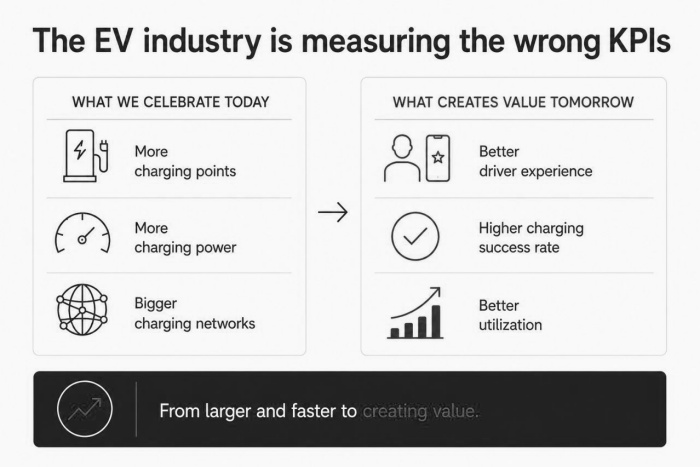
For years, our industry’s success has been measured by two numbers: how many chargers we’ve installed and how many kilowatts they can deliver. Over one million public charging points across Europe is an impressive figure. Megawatt charging has come a long way from the early 50 kW DC chargers.
These numbers are great for press releases. They rarely build successful businesses.
Don’t get me wrong—both metrics matter. They have been critical drivers of EV adoption. But as the industry matures, we are shifting from a technology arms race to an operational excellence race.
According to ChargerHelp!'s *2025 EV Charging Reliability Report*, while 98.7% to 99% of charging stations show as "online," the actual successful charge rate is only 71%. Nearly one in three charging attempts fails. New stations can achieve an 85% success rate in their first year, but that drops to around 70% after three years.
A station being "online" does not mean it is "available." This is the fatal flaw of traditional KPIs—they measure hardware status, not user experience.
J.D. Power’s research confirms the gap: in 2025, 14% of EV owners said they had visited a charging station but were unable to charge. Although this is an improvement from 19% in 2024, more than one in ten charging journeys still ends in failure. In Germany, 73% of respondents reported having experienced charging anomalies—failed starts or unexpected interruptions.
Fleet operators need to trust that EVs can integrate into daily operations with the same predictability as diesel. Reliability, predictable charging, and seamless fleet operations matter far more than peak power.
Drivers don't ask how many charging stations a city has. They simply expect chargers to be available, easy to use, and working when needed. More charging points add capacity but can still deliver a poor customer experience if reliability is lacking.
Charge point operators (CPOs) do not create value just by installing more chargers—they create value by keeping them operational. Every unnecessary hardware failure, software bug, or avoidable service intervention increases OPEX, lowers utilization, and delays profitability. CFOs need technology partners who can solve problems and improve the bottom line.
Porsche’s case is the clearest warning. In December 2025, Porsche announced it would gradually shut down its roughly 200 self-built charging stations in China. The reason was straightforward: average daily energy throughput at its stations was only 30% of the industry average; ultra-fast charger utilization consistently hovered below 15%; and annual maintenance cost per charger reached RMB 25,000 (about €3,200). Even a luxury brand cannot sustain stations that nobody uses.
Bosch closed its "Charge My EV" platform in March 2025. These exits by industry giants are not coincidental—the profitability of charging infrastructure is more fragile than many assume.
We need to start measuring what actually creates value:
Charge Success Rate:not just equipment online rate. The ChargeX Consortium has defined this as a core metric, covering initiation success, start time, session completion, and overall session success. Monta’s performance score framework also ranks charge success first. Industry-wide charge success reached 86% in 2025, but that still means 14% of attempts fail—each percentage point represents lost revenue and frustrated users.
First Time Charge Success Rate:a more honest reflection of user experience than traditional uptime. If users plug in and charge successfully on their first try, they trust the network. If they fail, they may never return.
Uptime:but measured from a user-perceivable perspective, not just system reports. ChargerHelp!'s report exposed a harsh reality: 98.7% system‑side availability hides a 71% actual charge success rate. True uptime should answer one question: when a user shows up, can they charge?
Driver Experience:the entire journey from finding a station, initiating a session, charging, and paying. The fragmented digital ecosystem—switching between multiple apps for planning, authentication, and payment—remains a major pain point.
Utilization:directly linked to profitability. Average industry utilization may be below 10%, which makes profitability impossible. A 15% utilization rate has historically been seen as the baseline threshold for profitability. Every percentage point improvement directly translates into revenue.
Site Payback Period:this is the number CFOs actually care about. A single fast charger costs roughly RMB 100,000 to 300,000 (€13,000–39,000), with payback typically taking 3 to 5 years. When the industry standard is "making only 2 cents per kWh," the payback period is the ultimate measure of whether the business model is viable.
High power and large networks attract headlines. Great customer experience, high utilization, and low operating costs build successful businesses.
We are still judging this industry by "how many" and "how powerful." But those numbers tell only half the story—the other, more important half is about whether those chargers actually work, whether they are actually used, and whether they actually make money.
It's time to stop optimizing the wrong KPIs. Let's start measuring what really matters.

 English
 Deutsch
 Español
 italiano
 русский
 português
 Svenska
 العربية
 Nederland
 norsk
norsk français