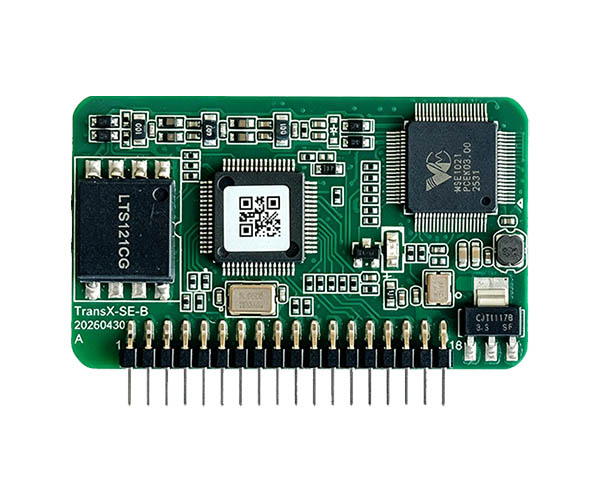
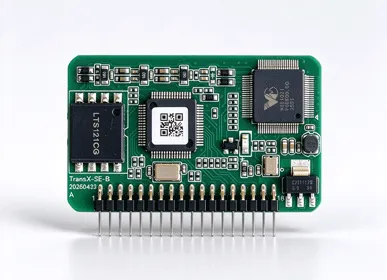
AP-SE-B Core Board iso15118-20 |
Technical parameters |
Package Dimensions | 50mm(L)×10mm(W)× 30mm(H),2.0mm pitch 18-pin single-row pin header |
Charging Interface | Supports CCS1,CCS2,NACS |
PLC Communication | Equipped with PLC communication transceiver circuit |
PD/PP Detection (Optional) | PD/PP signal detection function(circuit on AC main Control board) |
CP Detection(Optional) | CP voltage level detection function(circuit on AC Main control board)
|
PWM Generation (Optional) | PWM generation function( circuit on AC main control board) |
E-State Control(Optional) | CP voltage meeting E-state function(circuit on AC Main control board) |
Supported Standards | ISO15118-2EIM,ISO15118-2PnC,ISO15118-20: ISO15118-20EIM,ISO15118-20PnC,ISO15118- 20BPT(V2X) |
Communication Interfaces | UART×2,USB×1 |
Operating Temperature | -40°C~+85°C |
Power Supply | 5V(±0.2V):>600mA |
Logging and Upgrade | Supports OTA upgrade,log storage and log retrieval functions |
What AP-SE-B PLC Communication Module Does
AP-SE-B focuses on PLC and SECC communication between the electric vehicle and charging equipment.
Its core functions include:
PLC Communication
The module integrates a PLC communication transceiver circuit for communication through the charging interface.
ISO 15118 Protocol Support
AP-SE-B supports communication functions based on ISO 15118-2 and ISO 15118-20.
Host Controller Communication
Two UART interfaces allow the module to communicate with the MCU or processor on the AC EVSE main control board.
USB Connection
One USB interface is available for applicable configuration, upgrade, diagnostic or development functions.
Charging Communication Logging
The module supports log storage and log retrieval to assist with integration, troubleshooting and communication analysis.
Firmware Upgrade
Firmware upgrade is supported. The exact upgrade process and connection architecture should be confirmed in the integration documentation.
What AP-SE-B PLC Communication Module Does Not Replace
AP-SE-B is an embedded SECC communication module rather than a complete AC charging station controller.
The complete EVSE system may still require:
AC EVSE main controller
Contactor control
Energy metering
Residual-current protection
Overcurrent and surge protection
User interface
RFID or payment system
OCPP or backend communication
Network connectivity
Power supply
Charging socket or cable
Enclosure and thermal design
Depending on the selected hardware configuration, CP detection, PD/PP detection, PWM generation and E-state control circuits may be implemented on the AC main control board.
Provide your current controller architecture when requesting technical support so that AUPINS can help clarify the integration boundary.
Plug & Charge Integration
Plug & Charge allows a compatible electric vehicle and charging station to exchange identification and authorization information through ISO 15118 communication.
AP-SE-B supports ISO 15118 Plug & Charge communication functions, but a complete Plug & Charge deployment may also require:
EVSE and contract certificates
Certificate installation and update processes
PKI integration
Secure certificate storage
Compatible EVCC implementation
Charging backend integration
Charging operator or e-mobility service provider support
Project-specific testing
AUPINS should review the intended Plug & Charge architecture before the customer begins hardware and software integration.
ISO 15118-20 BPT and V2X Communication
AP-SE-B supports ISO 15118-20 BPT / V2X communication functions for projects evaluating bidirectional and next-generation smart charging.
Communication support does not independently create a complete vehicle-to-grid or bidirectional charging system.
A complete BPT project may also require:
A bidirectional onboard charger or compatible vehicle
Bidirectional power conversion hardware
Energy flow control
Grid-compliant protection
Metering
Energy management
Backend coordination
Applicable grid certification
Vehicle and EVSE interoperability validation
AP-SE-B can serve as the SECC communication component within the complete system architecture.
Evaluation Sample and Engineering Validation
Before selecting AP-SE-B for mass production, customers should evaluate the module with their own AC EVSE controller and target charging architecture.
A typical evaluation process may include:
1. Requirement Review
Provide the charger type, main controller, charging interface and required ISO 15118 functions.
2. Technical Document Review
Review the pin definition, mechanical drawing, communication protocol and external circuit requirements.
3. Sample Configuration
Confirm the required firmware version and optional hardware functions.
4. Host Communication Integration
Connect AP-SE-B to the AC EVSE main controller through UART or the applicable development interface.
5. PLC Communication Test
Verify communication between the EVSE and a compatible EV or EVCC test platform.
6. Charging Function Test
Evaluate EIM, Plug & Charge or ISO 15118-20 communication according to the project scope.
7. Diagnostic and Error Handling
Review communication logs, timeout handling, error recovery and firmware upgrade processes.
8. Production Configuration Confirmation
Confirm firmware version, interface settings, labeling and delivery requirements before mass production.
Application Scenarios of AP-SE-B PLC Communication Module
1. Smart Bidirectional Home Charging (V2H)
Enable intelligent bidirectional charging for residential energy management, with automatic backup-power switching during grid outages and vehicle discharge during peak electricity periods.
AP-SE-B can work with photovoltaic systems, energy storage systems and smart meters. Using ISO 15118-20 dynamic power profiles, the system can switch to vehicle-supplied power within milliseconds during an outage and help reduce household electricity costs by up to 30%.
2. Coordinated Charging for Commercial Buildings and Industrial Parks
Support intelligent load balancing across commercial buildings, business parks and industrial facilities to help prevent transformer overload while prioritizing critical vehicles.
The system can read the maximum charging current reported by the vehicle BMS and monitor the remaining transformer capacity in real time, dynamically allocating charging power across multiple vehicles.
Vehicle-priority scheduling can also be configured to give commuter buses, executive vehicles or other critical fleet vehicles priority access to higher charging power.
3. Fleet-Level V2G Virtual Power Plant (VPP)
Enable fleet aggregation and V2G participation through an AC charger PLC communication solution.
The module supports ISO 15118-20 interoperability and can be integrated into charging systems serving multiple vehicle brands, including passenger vehicles and light commercial vehicles.
It provides a communication foundation for aggregating distributed vehicle batteries into a virtual power plant and coordinating vehicle-to-grid energy exchange.
4. Plug & Charge for Hotels, Tourist Attractions and Shopping Centres
Provide a seamless Plug & Charge experience without requiring drivers to scan a QR code or complete a separate manual authorization process.
Using a TLS-encrypted local certificate chain, the charging system can authenticate a compatible vehicle even when the backend platform is temporarily offline.
This solution is suitable for hotels, tourist attractions, shopping centres and other high-traffic destinations, helping improve charging convenience and charger turnover by up to 40%.
ISO 15118-20 AC Charging Communication Module for Multiple Applications
One Communication Module for Multiple Charging Scenarios
AP-SE-B can be used across residential V2H systems, coordinated commercial charging projects and fleet-level VPP applications.
The module supports dynamic energy dispatch, load balancing and millisecond-level grid response, helping charging equipment manufacturers build more flexible and energy-aware AC charging products.
Local Plug & Charge Authentication
The module supports a local Plug & Charge certificate chain, allowing compatible vehicles to be authenticated without requiring a continuous connection to the backend platform.
It can also support low-temperature battery-preconditioning strategies to help improve winter charging efficiency by up to 30%.
Compatibility with multiple vehicle BMS platforms helps reduce integration complexity and development costs.
Designed for EV Charging Industry Partners
AP-SE-B is suitable for:
EV charger manufacturers
Industrial park and commercial-building EMS integrators
Fleet operators
V2G solution providers
Charging controller developers
Energy-management platform providers
AUPINS provides an integrated solution combining ISO 15118-20 protocol-stack capabilities with PLC communication hardware, helping customers accelerate product development and V2G grid-connection certification.
AP-SE-B or a Complete EVSE Controller?
| Requirement | AP-SE-B | Complete EVSE Controller |
| ISO 15118 PLC communication | Core function | May be included |
| Embedded into an existing main board | Suitable | Depends on controller |
| External host MCU | Required as part of the complete system | Depends on product |
| AC contactor control | Managed by the host system | May be integrated |
| Energy metering | External | May be integrated |
| OCPP communication | External unless separately added | May be integrated |
| Residual-current protection | External | Usually external or system-level |
| CP/PP/PWM circuits | Optional or host-board dependent | May be integrated |
| Best suited for | Manufacturers with their own EVSE controller | Customers requiring a more complete control platform |
Choose AP-SE-B when you already have an AC EVSE main controller and need to add PLC and ISO 15118 communication.
Choose a complete controller when you require a broader charging-control solution with additional system functions.
FAQ
What is AP-SE-B?
AP-SE-B is an embedded SECC PLC communication module for AC EV charging equipment. It supports communication between the EV and EVSE using ISO 15118-2 and ISO 15118-20.
Is AP-SE-B a complete AC EV charger controller?
No. AP-SE-B focuses on PLC and SECC communication. A complete charger normally also requires a host controller, power switching, metering, protection, user interface and other system components.
Which ISO 15118 versions are supported?
The current product specification lists support for ISO 15118-2 and ISO 15118-20.
Does AP-SE-B support Plug & Charge?
Yes, the published product specification lists ISO 15118-2 PnC and ISO 15118-20 PnC support. The complete project must also address certificates, PKI, backend integration and vehicle compatibility.
Does AP-SE-B support V2G?
The product supports ISO 15118-20 BPT / V2X communication functions. A complete V2G or bidirectional charging system also requires compatible vehicles, bidirectional power electronics and grid-control functions.
Is AP-SE-B designed for AC or DC chargers?
AP-SE-B is designed for IEC and SAE AC EV charging equipment.
Which charging interfaces are supported?
The published specification lists CCS1, CCS2 and NACS. Final applicability depends on the complete charging interface and EVSE architecture.
How does AP-SE-B communicate with the host controller?
The module provides two UART interfaces and one USB interface.
Does the module include CP and PP detection?
CP detection and PD/PP detection are listed as optional functions. Their circuits may be implemented on the AC EVSE main control board.
Does AP-SE-B generate the PWM signal?
PWM generation is listed as optional and may require a circuit on the AC main control board.
What power supply does the module require?
The current published specification lists a 5V DC ±0.2V supply and a supply capacity greater than 600mA. Final current consumption should be confirmed in the latest datasheet.
What is the operating temperature range?
The published operating temperature range is -40°C to +85°C.
Does AP-SE-B support firmware upgrades?
Yes. Firmware upgrade, log storage and log retrieval are listed as supported functions. The exact upgrade procedure should be confirmed in the integration documents.
Can I obtain a development sample?
Customers can submit their company, charger architecture and required ISO 15118 functions to request an evaluation sample.

 English
 Deutsch
 Español
 italiano
 русский
 português
 Svenska
 العربية
 Nederland
 norsk
norsk français