When connector reliability depends on consistent electrical contact, the internal contact structure matters as much as the connector housing itself. A crown spring contact uses multiple spring fingers to maintain radial pressure, while lamella and hyperboloid contacts pins use different geometries to distribute electrical and mechanical loads. Understanding these differences helps connector manufacturers select a contact structure based on current, mating frequency, space, and operating conditions.
Crown spring contacts pins, lamella contacts pins, and hyperboloid contact pins are spring-loaded electrical contact structures designed to maintain stable conduction between mating components. Although all three rely on multiple contact elements, their geometry creates different contact pressure, mating force, and current-transfer characteristics.
| Contact Type | Basic Structure | Main Characteristic | Typical Advantage |
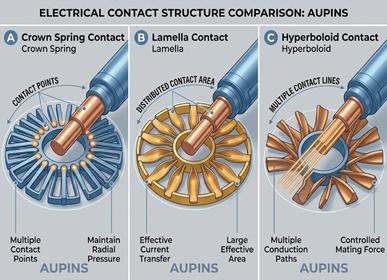
| Crown Spring contacts pins | Radial spring fingers | Multiple contact points | Stable contact pressure |
| Lamella contacts pins | Multiple formed elements | Distributed contact area | Effective current transfer |
| Hyperboloid contacts pins | Angled contact elements | Multiple contact lines | Controlled mating force |
For connector manufacturers, the distinction is not simply about shape. Contact resistance, mechanical life, insertion force, temperature range, and installation space all influence which design is suitable for a particular application.
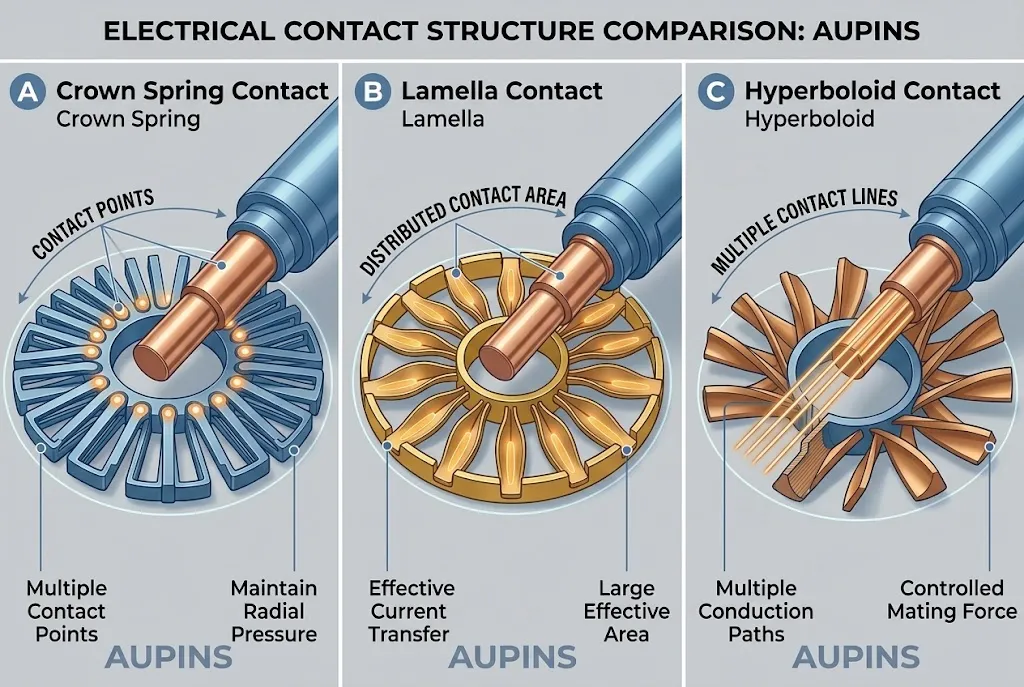
Crown spring contacts pins and lamella contacts pins both use flexible conductive elements to maintain pressure against a mating surface, but their element arrangement produces different mechanical behavior.
A crown spring contact consists of multiple spring fingers arranged around the mating interface. When a pin enters the contact, the fingers flex and maintain radial pressure against its surface. This creates several contact points while allowing the structure to accommodate certain dimensional variations.
AUPINS crown spring designs support at least 10,000 mechanical cycles and an operating temperature range of -40°C to 125°C. Gold and silver plating options are available for different electrical and environmental requirements. For applications involving repeated mating, the structure provides a practical balance between contact stability, spring force, and compact integration.
Lamella contacts pins use multiple formed conductive elements to create a distributed contact interface. Instead of relying on one continuous contact point, the elements work together to maintain electrical and mechanical contact around the mating surface.
AUPINS lamella contacts pins designs can also support at least 10,000 mechanical cycles and temperatures from -40°C to 125°C. Their distributed structure can provide a large effective contact area, making them suitable for connector designs where stable current transfer and mechanical durability need to be considered together.
When comparing crown spring and lamella structures, engineers should focus on the actual requirements of the connector:
Electrical performance: Contact resistance, current distribution, and temperature rise.
Mechanical performance: Insertion force, extraction force, mating cycles, and dimensional tolerance.
Integration: Contact dimensions, mating-pin geometry, connector size, and available installation space.
The choice therefore depends on the complete connector design rather than the contact structure alone.
Hyperboloid contacts use multiple angled contact elements to create several contact lines around a mating pin. This geometry gives them a different performance profile from conventional point-contact or basic spring-contact structures.
The angled elements in a hyperboloid contact form multiple electrical conduction paths around the mating pin. Instead of concentrating contact on one area, the structure distributes the interface around the circumference.
This geometry can also balance contact pressure with insertion and extraction force. As a result, hyperboloid designs are often considered where repeated mating, stable conduction, and controlled mechanical force are important.
AUPINS hyperboloid contacts support at least 10,000 mechanical cycles and an operating temperature range of -40°C to 125°C. Their structure is suitable for applications where reliable current transmission must be maintained through repeated mechanical operation.
For manufacturers evaluating hyperboloid connectors, several characteristics deserve attention:
Multiple contact paths: Several contact lines can support consistent electrical conduction.
Controlled mating force: The geometry can balance contact pressure with insertion and extraction requirements.
Mechanical durability: Flexible elements can maintain contact during repeated mating.
Design flexibility: Contact dimensions and configurations can be adapted to different connector requirements.
Choosing between crown spring, lamella, and hyperboloid contacts should not be based on contact shape alone. Engineers should evaluate how the contact behaves under the electrical, mechanical, and environmental conditions of the finished connector.
Electrical requirements include current capacity, contact resistance, voltage, peak load, and allowable temperature rise. Mechanical requirements include mating frequency, insertion and extraction force, dimensional tolerance, and expected service life. Environmental factors such as temperature, vibration, humidity, contamination, and installation space can also affect long-term reliability.
For connector testing and verification, the IEC 60512 series provides internationally recognized test and measurement specifications for electrical connectors and their components, including contacts and terminations.
For standardized connector families, requirements can also extend to dimensions, mechanical characteristics, electrical performance, environmental conditions, and testing. For example, the 2026 edition of IEC 61076-2-117 specifies such requirements for certain M12 to M40 circular connectors used for power, auxiliary, and data transmission.
These standards do not determine whether a crown spring, lamella, or hyperboloid design is universally suitable. Instead, they provide a useful framework for evaluating the finished connector against its intended operating requirements.
AUPINS develops electrical contact components using copper-alloy and beryllium-bronze materials, with gold and silver plating options. Its portfolio includes crown spring, lamella, and hyperboloid contact structures for different connector applications.
For manufacturers developing a new connector, the contact should be considered together with the conductor, housing, insulation, mating pin, and thermal conditions. AUPINS can customize contact dimensions and mechanical configurations according to specific application requirements.
For applications requiring repeated mating and stable radial contact, manufacturers can review the AUPINS crown spring contact range. AUPINS Crown Spring Contact Pins For designs requiring multiple contact lines and controlled mating characteristics, its hyperboloid connectors provide another contact architecture to evaluate.
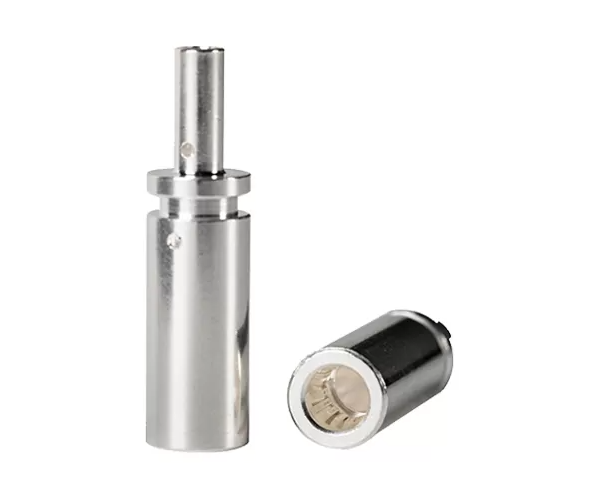
Crown spring contacts pins , lamella contacts pins, and hyperboloid contacts pins use different structural approaches to achieve reliable electrical conduction and mechanical contact. A crown spring contact relies on radial spring fingers, lamella designs distribute contact through multiple formed elements, while hyperboloid contacts create multiple contact lines around the mating pin.
The appropriate design depends on current requirements, contact resistance, mating cycles, mechanical force, environmental conditions, and available space. Comparing these factors together gives connector manufacturers a more practical basis for selecting and developing the right contact structure.
A crown spring contacts pins uses multiple radial spring fingers to maintain pressure against a mating pin or surface, providing multiple electrical contact points.
A lamella contact uses multiple formed conductive elements to create a distributed contact interface and support stable electrical conduction.
Hyperboloid contacts pins use angled conductive elements that create multiple contact lines around a mating pin, helping balance contact stability and mating force.
Mating force depends on the specific geometry, material, spring characteristics, and connector dimensions. Hyperboloid structures are commonly designed to balance contact pressure with controlled insertion and extraction force.
AUPINS crown spring contacts pins, lamella contacts pins, and hyperboloid contacts pins designs can support at least 10,000 mechanical cycles, depending on the specific product configuration and operating conditions.
AUPINS contact designs can support operating temperatures from -40°C to 125°C, depending on the specific contact construction and material configuration.
 English
 Deutsch
 Español
 italiano
 русский
 português
 Svenska
 العربية
 Nederland
 norsk
norsk français