ISO 15118 conformance testing has a reputation for being brutal. In practice, most failures do not come from misunderstanding the protocol. They come from six implementation details that only surface under a test harness.
If you are integrating a protocol board into a charger — or building your own stack — verify these before you book a lab slot.
Plug & Charge requires a contract certificate chain that validates against a V2G root CA, with proper handling of certificate installation, updates and expiry. Common failures:
●No support for certificate update before expiry, so a unit that passed last year fails this year
Private key storage in plain flash instead of a secure element
Incorrect handling of the "no contract certificate" case — the session should fall back to external identification, not abort
Test the full lifecycle, not just a happy-path session. Ask your board supplier how a certificate update is triggered and what happens if it fails mid-session.
●Private key storage in plain flash instead of a secure element
Incorrect handling of the "no contract certificate" case — the session should fall back to external identification, not abort
Test the full lifecycle, not just a happy-path session. Ask your board supplier how a certificate update is triggered and what happens if it fails mid-session.
●Incorrect handling of the "no contract certificate" case — the session should fall back to external identification, not abort
Test the full lifecycle, not just a happy-path session. Ask your board supplier how a certificate update is triggered and what happens if it fails mid-session.
Signal Level Attenuation Characterization is how the vehicle and charger agree on which PLC channel to use. On a bench it works every time. On a site with several chargers on adjacent cables, timing margins collapse.
Verify attenuation profile handling, retry counts and timeout behavior, and test with two charging points physically side by side — not one unit alone in a lab.
A significant installed base of vehicles still uses DIN 70121. If your board only speaks ISO 15118, those cars fail to start a DC session. Worse, the failure presents as a vehicle-side error, which sends your support team down the wrong path for weeks.
Requirement: automatic fallback by vehicle identification response, without manual configuration and without a reboot.
EXI is efficient and unforgiving. Schema deviation, incorrect handling of optional fields, and message size limits produce failures that look intermittent. Validate against the official schema, and test each message type independently rather than only as a session sequence.
Conformance suites probe timeout behavior deliberately: slow responses, premature messages, missing acknowledgements. A state machine that "usually works" fails here. Every state transition needs a defined timeout and a defined recovery path.
The DC session sequence requires the charger to close contactors only after the vehicle's precharge and insulation checks complete within tolerance. Boards that hard-code fixed delays rather than responding to actual vehicle signals pass on one vehicle model and fail on the next.
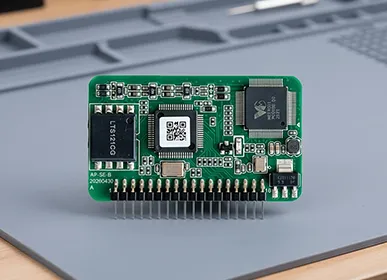
AUPINS develops EVCC and SECC protocol boards in-house — ISO 15118-2 and -20, DIN 70121 compatible, secure element based, with a documented host interface. They run in our own DC chargers, and they are available to charger manufacturers as drop-in modules.
If you are retrofitting a platform or building a new one, we can share the interface documentation and the conformance evidence upfront.
→ Ask for the EVCC/SECC technical datasheet.
 English
 Deutsch
 Español
 italiano
 русский
 português
 Svenska
 العربية
 Nederland
 norsk
 français