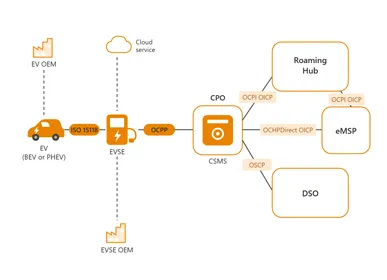
Every DC fast charger on a commercial site is holding two conversations at the same time. They run in parallel, they use different protocols, and they answer to different masters. Confusing them is the single most expensive misunderstanding in EV charging procurement.
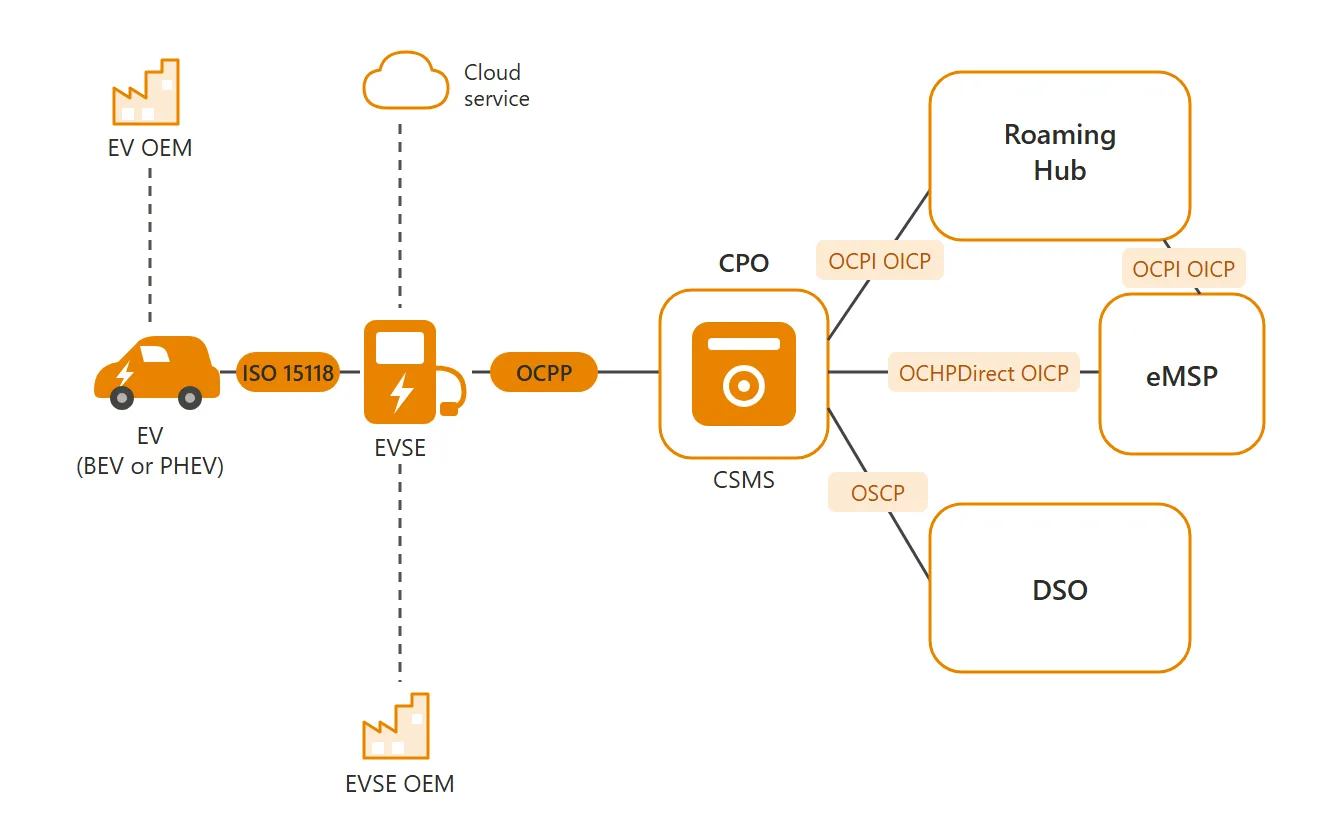
This is ISO 15118 — the international standard for digital communication between an electric vehicle and a charging station. It covers a narrow but critical scope:
Vehicle identity and authentication (who is this car, and whose account pays)
Charging parameter negotiation (how much power, what voltage window, what schedule)
Real-time power exchange and status during the session
Bidirectional energy transfer, known as V2G
When a driver plugs in and the session starts without a card, an app, or a single tap, ISO 15118 is what happened. That is Plug & Charge.
Real-time power exchange and status during the session
Bidirectional energy transfer, known as V2G
When a driver plugs in and the session starts without a card, an app, or a single tap, ISO 15118 is what happened. That is Plug & Charge.
Bidirectional energy transfer, known as V2GWhen a driver plugs in and the session starts without a card, an app, or a single tap, ISO 15118 is what happened. That is Plug & Charge.
When a driver plugs in and the session starts without a card, an app, or a single tap, ISO 15118 is what happened. That is Plug & Charge.
This is OCPP — the Open Charge Point Protocol, maintained by the Open Charge Alliance. It has nothing to do with the vehicle. Its entire job is connecting the station to the backend management system (CSMS):
Meter values and session records for billing
Fault codes and alarms for maintenance
Remote start, stop and reset commands
Load management across a site
Firmware updates and configuration changes
A charger can be fully OCPP-compliant and still be unable to talk to a modern vehicle beyond basic PWM signaling. It will charge, and it will bill — but it cannot do Plug & Charge, cannot negotiate a charging schedule, and cannot participate in any V2G program.The reverse is equally common: a charger with a solid ISO 15118 stack but a bare-bones OCPP implementation becomes a site the operator has to visit in person. Every restart, every firmware fix, every tariff change turns into a drive.
The reverse is equally common: a charger with a solid ISO 15118 stack but a bare-bones OCPP implementation becomes a site the operator has to visit in person. Every restart, every firmware fix, every tariff change turns into a drive.
When you evaluate a charger supplier, do not ask whether they "support smart charging." Ask two specific questions instead:
1. "Which ISO 15118 implementation is in the vehicle interface — -2, -20, or both? And is DIN 70121 supported as a fallback?"
The fallback matters more than buyers expect. A large share of vehicles on the road today still rely on DIN 70121. A charger that speaks only ISO 15118-20 will fail on them, and the failure looks like a charger fault, not a protocol gap.
2. "Which OCPP version does the station speak, and over which transport?"
"OCPP 1.6J" alone is incomplete. The answer you want is "1.6J over secure WebSocket," plus a defined path to 2.0.1 — because 2.0.1 is where certificate management, ISO 15118 integration and richer device modeling live.A supplier that answers both precisely is a supplier that owns its communication stack. One that answers vaguely is usually integrating third-party modules it cannot debug.
A supplier that answers both precisely is a supplier that owns its communication stack. One that answers vaguely is usually integrating third-party modules it cannot debug.
At AUPINS , both conversations are developed in-house. Our ISO 15118 protocol boards (EVCC and SECC) run -2 and -20 with DIN 70121 compatibility, and our DC fast chargers ship with OCPP 1.6J over WSS and a committed 2.0.1 upgrade path.If you are specifying a charger — or building one — start by making sure both conversations are on the table.
If you are specifying a charger — or building one — start by making sure both conversations are on the table.
 English
 Deutsch
 Español
 italiano
 русский
 português
 Svenska
 العربية
 Nederland
 norsk
 français